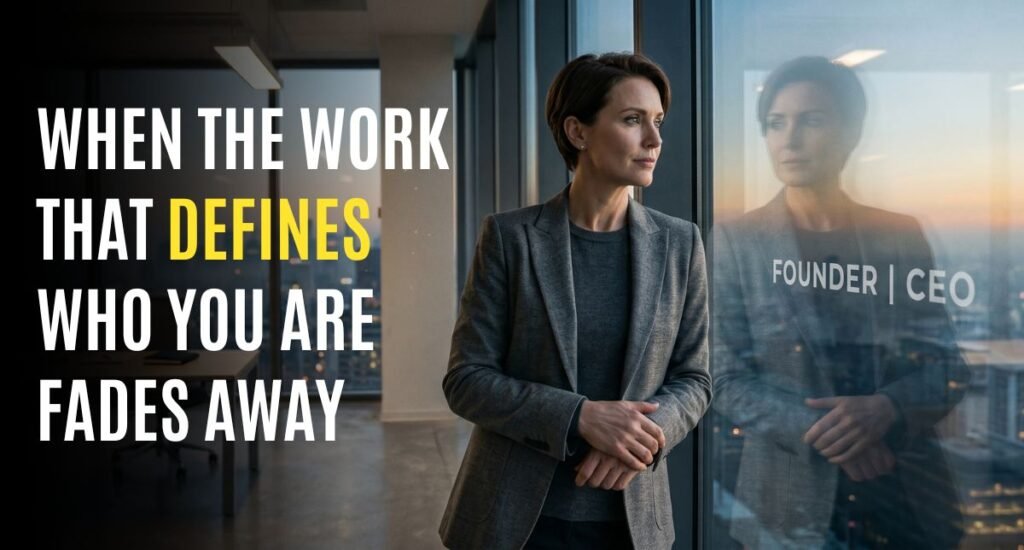
Some of the most unprepared individuals for the confusion that arises in our lives are those that experience disruption due to changes rather than failures. Titles change; companies pivot; chapters close; versions of ourselves fade away as quickly as they emerged. Standing in a space that appears identical yet feeling as though you’re a foreigner within your own existence is a sensation few can articulate.
Most leaders/entrepreneurs claim to know who they are outside of their work. On a Tuesday afternoon while completing a product launch, they’ll express confidence. Six weeks later, after an exit, a setback, a transition, or success (which felt empty), uncertainty becomes apparent in their response.
High-achieving professionals equate their identity and role. Over time, nearly undetectably, the distinction between who you are and what you do becomes ambiguous, often resulting in the two appearing to be equivalent. Your instinctual behaviors become reflective of your roles. Relationships evolve based upon your positions. Energy, time, and your worth become tied to productivity/output and impact. The transition occurs before you realize it because it’s perceived as personal growth, as having purpose, as finally achieving “who” you’ve been striving to become.
At times, something simply transitions. This doesn’t necessarily need to be an adverse event. In many cases, it’s simply a transition, sometimes naturally occurring, other times intentionally so. However, the psychological foundation beneath the surface transitions in ways people rarely speak about truthfully since acknowledging this phenomenon is difficult for ambitious people; ultimately, they stop being a person with a role and become a role with a person in it.
Recovery from such phenomena isn’t about reinvention or discovering a new purpose or anything else you might read in well-written articles that provide neat conclusions. Recovery is slower and stranger than that. Recovery involves embracing a form of yourself devoid of performance, titles, and metrics to substantiate claims of achievement. Simply put, it is about experiencing genuine thought, fear, and desire without the professional constructs that render these feelings organized and meaningful.
As the speed of transformation in how we work, lead, and create continues to increase in 2026, it creates an environment where role instability is almost unavoidable. As industries transform much quicker than individuals’ identities, the founder you were three years ago may not be the founder needed today. If your sense of self relied solely on the previous version of yourself, the stress of this change is very real regardless of whether others see it.
Leaders who remain grounded aren’t those who lost themselves in their work. Rather, leaders that maintain grounding are those who had to rediscover themselves outside of their work and remained curious regarding what they learned during that journey.