
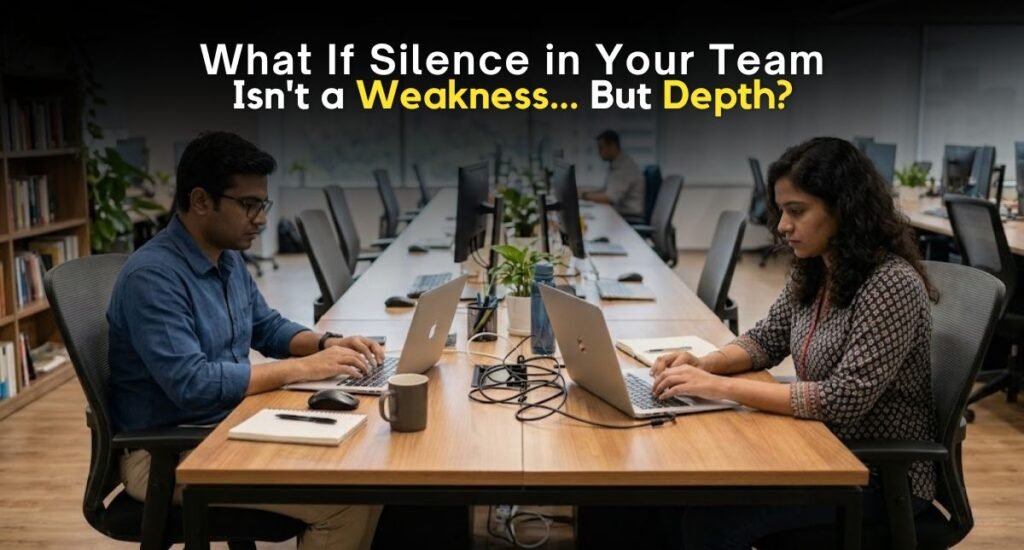
The quietest members of your team are likely to be the smartest ones. But nobody’s paying attention because silence is misinterpreted as lack of interest.
How can confidence ever represent intelligence?
Every organization does it, every single day. Hiring decisions, boardroom discussions, staff meetings… And nobody realizes what’s going on. The person who speaks first gets credited as the strategic thinker, but the one who fills silent spaces with conviction gets labeled “leadership material”… and the person sitting quietly processing deep thoughts connecting dots that nobody else has even noticed yet… Gets ignored and passed over. Occasionally gets managed out. Organizations have built systems that reward the display of intelligence rather than the actual practice of it. And organizations don’t know how much they’re losing by doing so.
Why companies have never had to address what psychologists call the confidence bias:
Research has shown for decades that humans equate fluency (smooth speech) with credibility. If someone speaks smoothly, assertively & without hesitation, our brains automatically register them as more competent than they actually may be.
This isn’t a flaw in a few managers. This is a deeper human bias that gets amplified in professional environments through culture, hierarchies & unstated expectations to “have the answer” before the question is even finished being asked.
As a result… organizations continuously over-promote individuals who can sound certain and continuously under-utilize individuals who can be right.
Real examples of this in today’s workplace
An example of this would be the senior analyst who sent a one-paragraph email after a forty-minute meeting where everyone was confidently wrong; the entire project direction got rewritten based on their insight.
Another example would be the product manager who never dominates a meeting space; however, his judgment, which took him a while to surface, ultimately ended up being the only one that made sense of all the data collected. He accounted for human behavior vs. just data points.
Lastly, an example would be the founder whose funding almost didn’t happen; she couldn’t demonstrate certainty to investors like expected, although her market insights were sharper than anyone else’s in the room.
These types of people exist within most teams. They are not disengaged; they are not ambitious; they process differently; they communicate differently; their value usually goes unnoticed until their ideas finally get heard.
The structural leadership problem that develops from these actions
This is more than just an individual issue. It is a systemic issue by consistently rewarding performative Confidence organizations are subtly training their entire organization to optimize appearance over accuracy. Employees learn speaking matters more than being correct. Volume earns visibility. False certainty earns more trust than nuance.
In today’s world, where AI can generate confident-sounding answers within seconds, the leaders who will matter most are those who can remain still during complexity, ask better questions, and avoid the urge to present certainty about things they aren’t sure about. This type of thinking is exactly the kind of thinking that is filtered out at both levels (individual level + organizational structure).
What changes must occur
It’s not about telling quiet people to speak up more; that advice misses the point completely. Change must take place at a higher level (leadership/systems). Changes regarding how meetings are structured, how ideas are requested, how performance is evaluated & how “presence” is defined inside an organization.
The best forward-thinking leaders in 2026 are already asking different questions. Not “Who spoke the most?” but “Whose thinking moved us forward?” Not “Who commands the room?” but “Who sees what’s missing from the room?” That reframe alone changes everything about who gets developed, promoted & trusted to make decisions that matter.
A thought worth considering
Next time you leave a meeting feeling like great ideas went unheard, consider whether your organization created a safe space for depth to show or simply a space for confidence to act.