
You are looking at the universe, at the sky, but most likely you aren’t looking at it because of an interest in astronomy.
You are probably looking at it because something in your life is no longer making sense.
Late at night after you have been on the phone scrolling reels until you can’t go any further or your mind is still not at peace, after a day that was busy but somehow felt empty. You are scrolling through apps on your phone, but you really don’t know why. You close an app and open another app, but you still can’t shake the feeling of restlessness.
Then, when you look up at the sky, it seems larger than your thoughts. For a couple of seconds, all of the noise inside you becomes silent. That quiet moment isn’t about the stars; it’s about relief.
Modern Life Is Loud. The Universe Is One of the Few Quiet Places Left.

In today’s world we have a lot of “noise,” referring to “mental noise.” We don’t hear car horns or construction all day long like we used to, but the mental noise that we experience on a daily basis is much different than traffic noise. It is constant updates, constant opinions, constant comparisons, and constant pressure to do something that is “meaningful.”
Although we may be constantly connected through technology, most of the people we meet seem to feel a strange sense of disconnection from themselves. Most conversations are rushed, most achievements are short-lived, and most people feel guilt for resting.
When someone thinks about the universe, it is not necessarily an attempt to get away from their reality. They are attempting to take a breath. The universe does not require your response. The universe does not require performance. The universe does not require productivity. The universe simply exists. And that is relatively rare in today’s world.
Looking at the Universe Makes Our Problems Feel Smaller, But Not Meaningless

There’s an incorrect assumption that thinking about the universe causes one to think the purpose of life is not that important. When you realise how long ago certain stars were created, or how slowly cosmic time passes by – your everyday worries don’t go away. However, at this point, those everyday worries do not seem as important or central to your entire existence.
The fact that what you choose to do for a living will not define your value; an unread email doesn’t define who you are. A bad week will not define whether you are succeeding or failing at your life.
The universe also gives people a sense of being part of something much bigger than themselves, which can have a very grounding effect on someone who lives their life constantly focused on what they accomplish today.
The Universe as a Mirror for Human Fear, Hope, and Identity
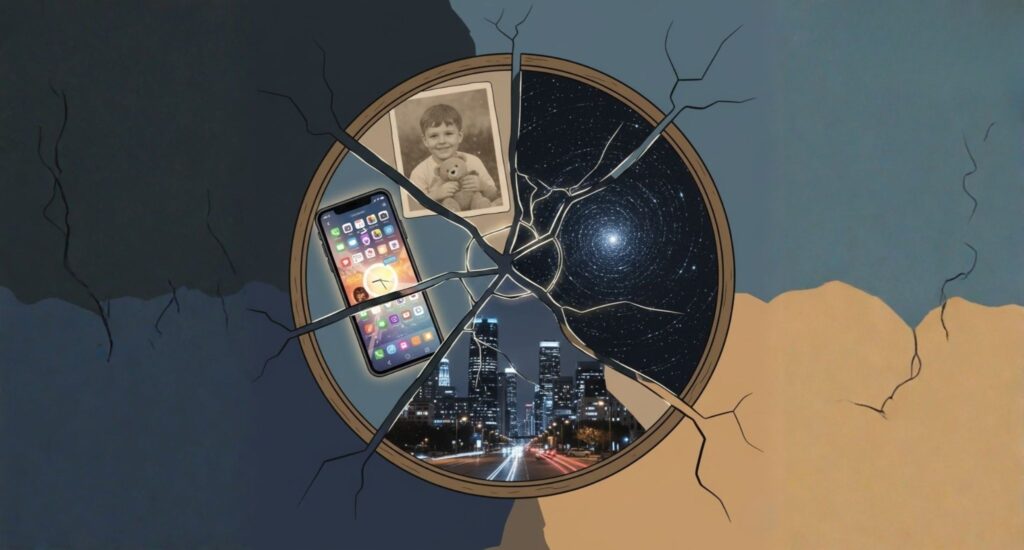
People usually view the universe as something “out there” and distant from their own lives. However, this isn’t always the case. In fact, we tend to view the universe through ourselves. Our feelings (fears, hopes, and questions) subtly influence what we see and what we find uncomfortable in the universe.
Space has many meanings when people discuss it, but ultimately, it means something to do with one’s feeling of belonging, sense of self-importance, and identity. Because the universe is large enough to contain emotions you have no idea how to otherwise express, it functions as a mirror in many cases.
This is why people across cultures and generations are fascinated by space. Images that evoke the same emotional response in people may have a completely opposite reaction depending on who is viewing them. Some people are comforted by the universe — reminding them that their problems will be short-lived. Others are made uneasy by the universe — reminding them that humans are not central to the universe.
What you feel when you look at the universe often reveals much more about your internal state, rather than anything about the universe itself.
– When life seems to be too much, the universe provides a way to gain perspective.
– When life feels empty and lonely, the universe raises questions regarding connectivity.
– When life seems uncertain, the universe reflects the uncertainty right back at you – with honesty.
The universe does not tell us who we are. But the universe presents an enormous canvas for us to project upon while searching for identity. And in that reflection, many people come to a better understanding of themselves.
Are We Alone? Or Are We Afraid of Being Alone?

In today’s world, with modern technology and social media, our lives are highly connected (hyper-connected); however, many individuals are feeling more isolated than their ancestors did. They may communicate frequently but rarely experience meaningful conversations. Their messages can be instant, but they rarely get real understanding. This makes finding comfort in the possibility of other forms of life, like aliens in the universe, seem almost natural.
Hope: If we find other life, then we will have a new type of connection with others outside of Earth.
Fear: If we do not find any, then we will face the reality of being completely alone in the universe.
Therefore, when humans enquire as to whether we are alone, they are actually asking themselves: Does isolation come naturally to us, or could there be some level of connectivity on a much larger scale?
Why the Universe Feels More Relevant in the Age of Social Media
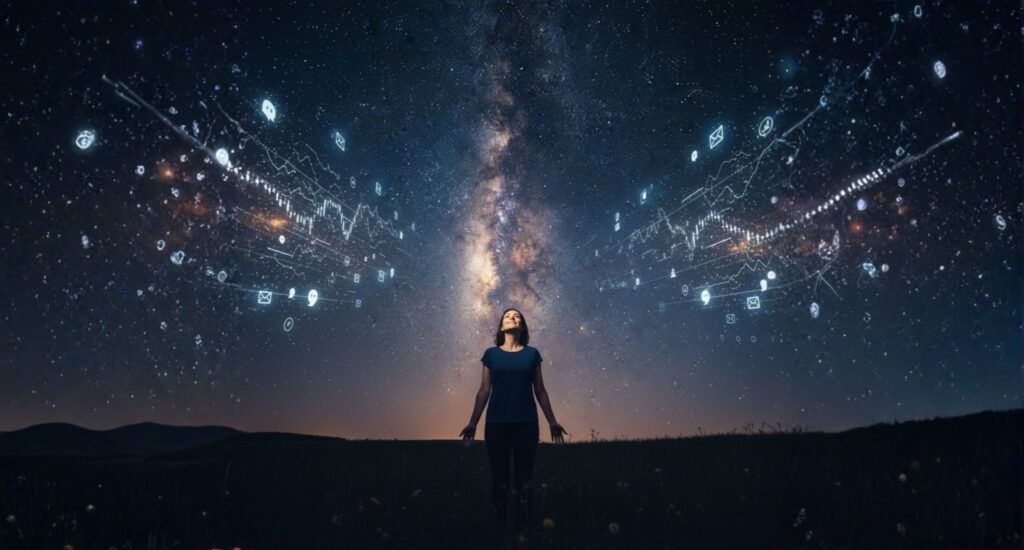
Even though it may seem unreasonable, the more connected we become with technology, the more we realise how large the universe truly is. Social media was designed to help people connect more than ever before, but for many, it has quietly changed the way they experience the world by using data to evaluate everything about the way they live (i.e., likes, views, followers, reach, and engagement), as well as the way they react emotionally and to certain things.
Consequently, the universe can sometimes feel like the total opposite of what social media provides.
– The universe doesn’t grade you.
– The universe doesn’t judge you.
– The universe doesn’t provide a report card based upon your accomplishments.
This contrast is significant.
According to global studies on digital wellbeing, every year the time people spend online (screen time) continues to grow, as does the number of people who are saying they feel anxious, restless, and tired from comparing themselves to everyone else’s perfectly curated lives and accelerated timelines, which creates subtle pressure to continue “doing”, “achieving”, and “proving” oneself.
When people view videos of the successes of other people as they scroll through their social media feeds, followed immediately after by a video of a galaxy, a star exploding, or a timelapse of the stars in the night sky, something occurs in their brain. Their brain ceases racing, and the urge to hurry up and solve problems quickly is gone. The problems don’t go away, but the way people see them changes.
Understand, social media compresses the time people experience into seconds, but the universe expands the time people experience over millions of years. This contrast is incredibly strong.
In today’s society, with numerous outside distractions for people’s attention, the universe is an inside pull working to bring people back to themselves. It reminds people that they are participating in the process of life unfolding at the pace it will unfold and that they are not competing in a timed game.
When Life Feels Reduced to Metrics, the Universe Feels Human Again
Many people today may have an impression or feeling they are being audited in their lives.
– Their productivity is monitored,
– Their progress is measured, and
– Their worth is tied to those measures.
The repeated exposure to these measures of success over time may leave many people feeling less human and more like a number.
That feeling is removed from us when we experience the universe.
The universe does not care how visible you are.
The universe does not care how productive you are each day.
The universe does not equate your existence to what you produce.
Therefore, space-related media provides viewers with an emotional grounding experience. Space-related media allows individuals to feel like human beings rather than just statistics. In a world where everyone’s value is always calculated, the universe is providing a very unique gift to us: our existence without judgement.
The Indian Way of Looking at the Universe Is Different

India is one of the few countries in which, since before there was science, the universe has been seen as part of everyone’s life. The ancient Indians were able to connect their cosmology to their culture, philosophy, and day-to-day activities. Because of this, Indians who have traditionally thought of the universe are likely to think of it in the same way today.
As opposed to asking, “What is the universe made up of?” Indians traditionally asked, “How does the universe move, and what rhythm does life follow?”
Concepts such as karma, reincarnation, and cycles created an interdependence in all of existence and therefore placed human life into its proper place in relation to all of existence. Therefore, the cultural background provided a sense of comfort in considering the universe and not a sense of fear.
– The universe is not something far away from us; it is a representation of ourselves.
Time is not running out; time is in cycles.
– It is not necessary for us to try and find meaning in our lives quickly; it will happen in its own due time.
Although the process of modernisation has changed the way many Indians live, when the pressures of modern living get to be too much (deadlines, expectations, family responsibilities), many people fall back to greater perspectives on their lives.
Many use astrology, meditation, spirituality, and even simple observations of the stars to help them manage their emotions, and not because of superstitions.
The relationship between Indians and the universe is based upon finding their place in it and not about trying to control it. This is a very important point of distinction in a world that continues to be fuelled by the pace of speed.
A Quiet Ending, Not a Final Answer

The universe does not give an explanation as to why things happen as they do in our lives; it will not provide guidance as to who we should be and/or how we should live.
Perhaps that’s the reason it still has value to many.
In today’s society that is driven by wanting to know all the answers, the universe provides room for questioning. Room for wondering. Room for doubt. Room for sitting on questions that don’t require an answer right now.
Meaning is not provided to us in the form of a conclusion. Meaning is developed over time through new perspectives, reflection, and accepting where you’re at in your journey. The universe does not demand that we comprehend its workings; the universe merely asks that we take the time to observe, ponder, and experience.
When people look up toward the sky, they are not avoiding their problems. They are putting their life in perspective. They are reminded that having unanswered questions isn’t a sign of weakness; being uncertain about one’s future isn’t a sign of weakness either. Searching for meaning will continue even after one finds some answers. The act of searching for answers has meaning too.
And the universe may teach us the most honest lesson of all:
It is acceptable that we don’t have everything figured out sometimes.
Sometimes just looking up is enough.
FAQs:
1. Why do humans look for meaning in the universe?
People can do routine jobs, etc., and still be searching for “why” they’re doing all this. Because people need something larger than their problems, so they naturally seek the universe as an explanation. Also, when people are feeling lost or confused, they seek connection with the universe because it gives them a way to find grounding rather than feeling lost.
2. Is the search for meaning in the universe scientific or emotional?
Mostly it begins with emotion. Curiosity, overwhelm, loneliness, and thoughtfulness, people often seek out the universe because of emotions and then use science to help explain what they see. However, it’s the emotional reasons (wanting to have perspective, wanting to feel reassured, wanting to believe there is more to life than just doing tasks and meeting deadlines) that motivate people to care about the universe.
3. Why do people think about the universe more during difficult times?
During times of instability, people begin to look for meaning instead of simply finding ways to fix their immediate problems. During times of burnout, loss, or confusion, the universe provides a distance between the person and the pain they’re experiencing while still allowing them to acknowledge the pain exists. The universe also allows people to realise that uncertainty is a natural aspect of existence and that it does not represent a personal failure.
4. Does science reduce the mystery and meaning of the universe?
In general, no. For most people, learning about the vastness and strangeness of the universe does not diminish their sense of wonder; instead, it enhances it. Science may help us learn how certain aspects of the universe function, but meaning is derived from how the answers to these questions make people feel.
5. Why does the universe feel more relevant in modern life than before?
The pace of modern life is fast-paced, noisy, and competitive. Every element of our lives is constantly being evaluated and compared. In contrast to this chaos and competition, the universe represents a world that is outside of the measurement and time constraints of modern life. The universe has no concern for whether you are productive, popular, or successful. As such, the universe represents an unfiltered and refreshing source of honesty for many people.
6. Is searching for meaning in the universe linked to religion or spirituality?
Sometimes, but not always. While some people choose to reflect on the universe through faith and/or science, others may utilise philosophy, curiosity, etc. to do the same. What is consistent across people who are interested in reflecting upon the universe is not a specific belief system but a desire to reflect on where they fit within the universe. And for many, the universe provides a neutral space for them to ponder these types of questions without providing a specific answer.