Every generation believes it’s living through the most extraordinary time in history, yet our generation truly is. We’re standing at an unusual crossroad where human behavior, digital intelligence, and cosmic discoveries are influencing one another in ways no one imagined even 20 years ago.
Look around: your phone knows your habits, Mars is being mapped like a neighborhood, and AI can analyze star systems faster than astronomers. Something bigger is happening, a silent merging of human life, technology, and the universe itself.
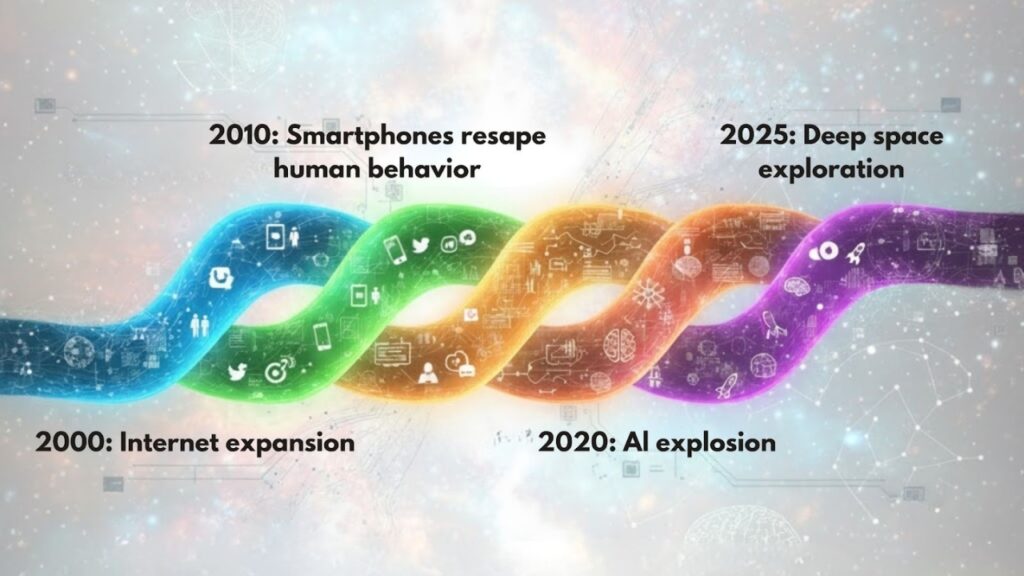
1. Humans Are Becoming More Digital Than Biological
Take a moment and observe your day. Before you even sip your morning tea, you’ve probably:
- Checked your messages
- Scanned notifications
- Opened a social app
- Viewed your schedule
- Browsed headlines
In those first three minutes, your brain interacts more with digital information than with the physical world.
This subtle shift means: We all are living life in two realities at once: the physical life and the digital life.
And as strange as this sounds, it’s only getting deeper now. Your watch can track your heartbeat. Your apps store your memories. Even your decisions (what you want to watch, eat, buy) are influenced by the algorithms that understands you better than some people do.
Technology is not replacing humanity, it’s absorbing parts of it.
2. Technology Is Becoming the Bridge to the Universe
For centuries, humans looked at stars with curiosity but had no real access to the cosmos.
Today, technology changed everything.
- We have the telescopes that can see 13 billion years into the past.
- We have the rovers that are traveling across other planets.
- We have AI scanning the universe for signs of life.
And soon, we might have humans stepping on Mars.
Technology has expanded our reach so far that we now explore the universe from our living rooms. Every cosmic image you see galaxies, nebulae, and exoplanets is delivered to you through machines acting as your extended senses.
- Human curiosity built the tools.
- The tools built a new understanding of the universe.
- And the universe now shapes how we innovate.
3. The Universe Influences Technology More Than We Notice
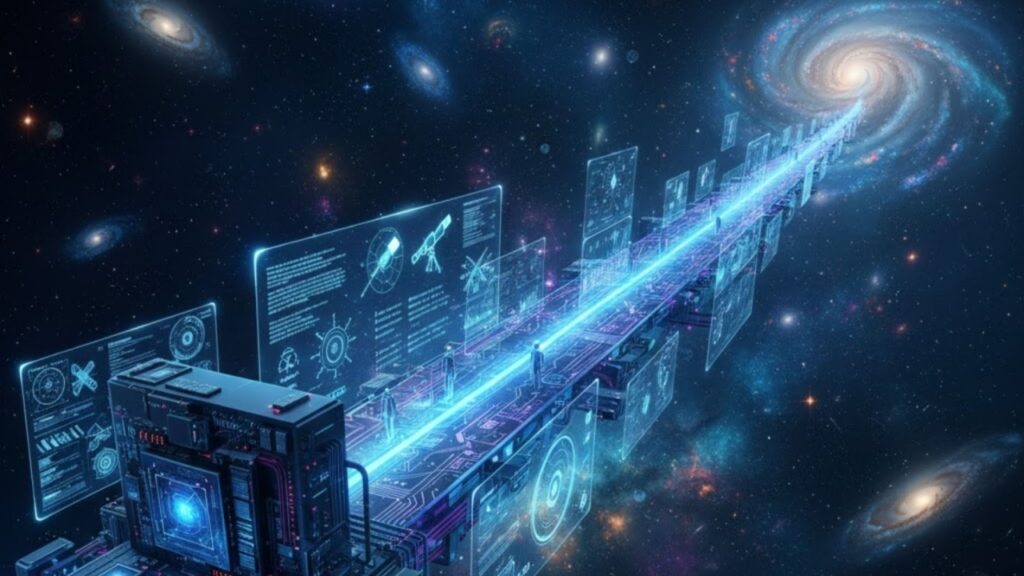
This part is fascinating. We often think we create technology from imagination. But a lot of our most powerful inventions come directly from universal patterns.
Consider this:
- The structure of computer networks resembles the structure of galaxies.
- Neural networks in AI mimic the way neurons fire in the human brain, an evolved product of the cosmic evolution.
- Quantum computing is based on principle that governs the atoms and particles in the universe.
The logic of the universe is quietly embedded in every major technological breakthrough.
We’re not just learning from space, we’re copying it.
4. So Where Do Human Fits Into All This?
Humans are the connecting links the threads weaving technology and the universe into a single narrative.
- We use technology to study the universe.
- We use the universe to inspire technology.
And both reshape how we live, think, and evolve.
This synergy means:
- Our decisions are more data-driven
- Our questions are more cosmic
- Our tools are more intelligent
- Our identity is more connected
The future human will not be defined only by biology but by how well we adapt to a universe powered by technology and curiosity.
5. What the Future Could Look Like
- AI systems exploring deep space on our behalf – AIs that can travel where humans cannot analyzing planets, decoding cosmic signals, mapping new worlds.
- Humans living in a hybrid reality – Digital identity + biological identity blending into one experience.
- Space-inspired innovations shaping daily life – From energy systems to transport to medicine breakthroughs based on universal principles.
- Technology acting as a second brain – Helping humans think faster, solve bigger problems, and explore deeper questions.
The future doesn’t belong to humans alone. It belongs to humans enhanced by technology, exploring a universe full of endless possibilities.
Conclusion
The connection between humans, technology, and universe is no longer theoretical; it is visible everywhere around us. We are living in a time where digital intelligence amplifies the human potential, and discoveries in the universe reshape how technologies evolve. Together, they create a very powerful and unstoppable cycle of growth.
As we move forward, one thing becomes clear: We are not just living in the universe, we are learning to live with it, through technology, as one connected system.