Something Shifted in How We Communicate, and Most of Us Didn’t Notice When It Happened. At some point in the last year or two, a strange inversion quietly began.
AI got better at sounding warm, thoughtful, and emotionally aware, and somewhere in parallel, humans started communicating in ways that sound increasingly optimized, structured, and oddly frictionless. The irony is almost too uncomfortable to sit with; we spent years worrying that AI would become too robotic. What we didn’t anticipate is that we might start becoming a little robotic ourselves.
It shows up in almost invisible ways in how we write emails, how we structure our thoughts before sharing them, how we respond to messages, and how we frame our ideas in meetings. And if you slow down long enough to notice it, something about it feels quietly unsettling.
The Way We Write Has Already Changed
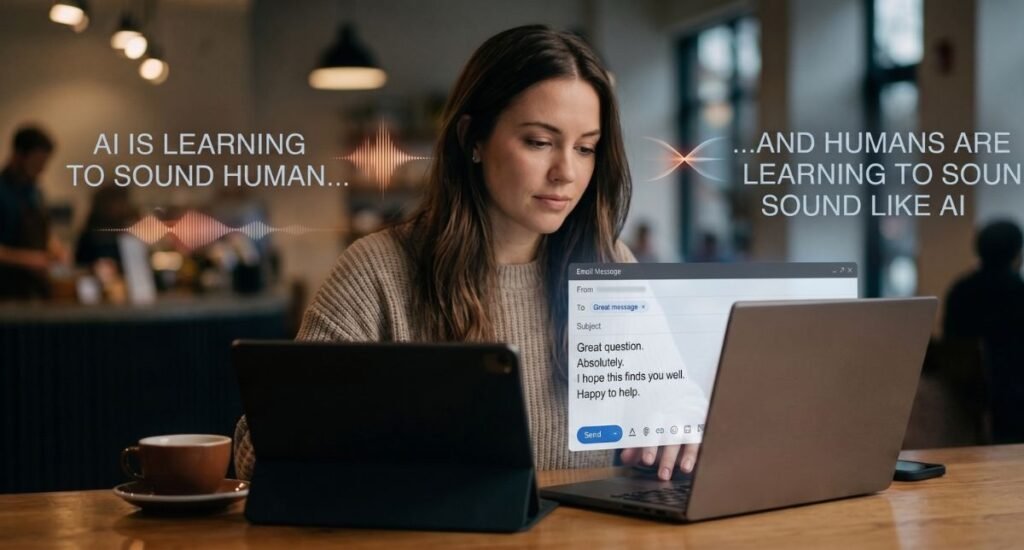
Think about how you wrote a professional email five years ago versus how you write one today, there is a good chance that somewhere in your recent drafts, you’ve used phrases like “great question,” “absolutely,” “I hope this finds you well,” or “happy to help with that.” Phrases that are technically warm but carry almost no personal weight. Phrases that, once you felt honest, you didn’t really feel; you just reached for them because they fit, because they were smooth, because they made no friction.
Now consider that these are also among the most common patterns of AI communication.
This is no accident, as the more people chat to AI outputs, the more they read, edit, and accept; the more those patterns leak into natural expression. Language is a deeply habitual thing; we soak up what’s around us. And right now, what’s around us, ‘professionally’ and digitally, is a structured, optimized text, all designed to sound acceptable to everyone and specific to no one,
The Deeper Change Is Happening Inside How We Think
The communication change is visible; this is also harder to name and possibly more profound, as it is the cognitive change.
A growing tendency, almost imperceptible, for people to pre-structure their thoughts in ways that seem to nod almost algorithmically before they express them, to lead by starting with a summary, To bullet point yourself to something internally before saying it aloud, to ask of yourself almost unconsciously, “What’s the most efficient way to package this idea for human consumption?” Rather than “what is the most honest way for me to express it?”
In 2026, with AI available everywhere in our workflows, in our emails, in our content generation, and even in our text messages to one another, the line that we draw relative to whose work is all machine and whose is human may genuinely begin to blur. And that blurriness is worth thinking on not in panic but genuine curiosity.
What Gets Lost in the Optimization
When we optimize our communication, markers of being human start to quietly leave the room.
- The half-baked thought that gets us somewhere thoughtful and strange,
- The emotional tangent that contains the real point,
- The socially awkward pause that actually communicates much more than the sentence after it,
- The obscenely specific and human detail that makes another person feel seen, not data processed.
These are features, not bugs. Textures of a real human connection, and they are becoming increasingly and unsettlingly rare in places where we touch both our business and personal lives, not because any of us don’t know it when we’re feeling it, but because the environments we are part of have made that feeling seem inappropriate, inefficient, or deeply so.
What This Means for Leadership and Human Expressiveness in 2026
The people who will stand out and stay awful in the next few years are not going to be the people who sound the most polished. That bar has been permanently lowered, and the machines can clear it just fine.
What will become genuinely rare, genuinely valuable, and genuinely unpromptable is the stuff that sounds like it came out of a specific human mouth, out of a specific set of experiences, contradictions, and lumps of emotion … justice? Missing time? (I’m still hunting the right phrasing.) Oh wait.
Your pitches and ideas are expressed in a way that carries your way of seeing, and the email sounds like you, and well, this matters.
Authenticity is no longer a desired personal trait that we’ve established into an actual value proposition for human performance. In a world where AI fluency is ambient and universal, it is becoming currency we will pay each other for in ways that require neither prompting nor generating.
A Quiet Realization Belonging to Sufficiently Human Work to Sit With
We are very quietly living through this fascinating moment where the generations are still learning to feel, and the humans are learning to process, and both of them are headed toward the center of something together, and neither of them quite understands the shape of what that center is yet.
It is not so much interesting to me whether AI is merely becoming more human, but whether we are gradually becoming farther from becoming human and whether we notice that.
Have you caught yourself communicating in ways less optimized than they could be that sounded way more human?