
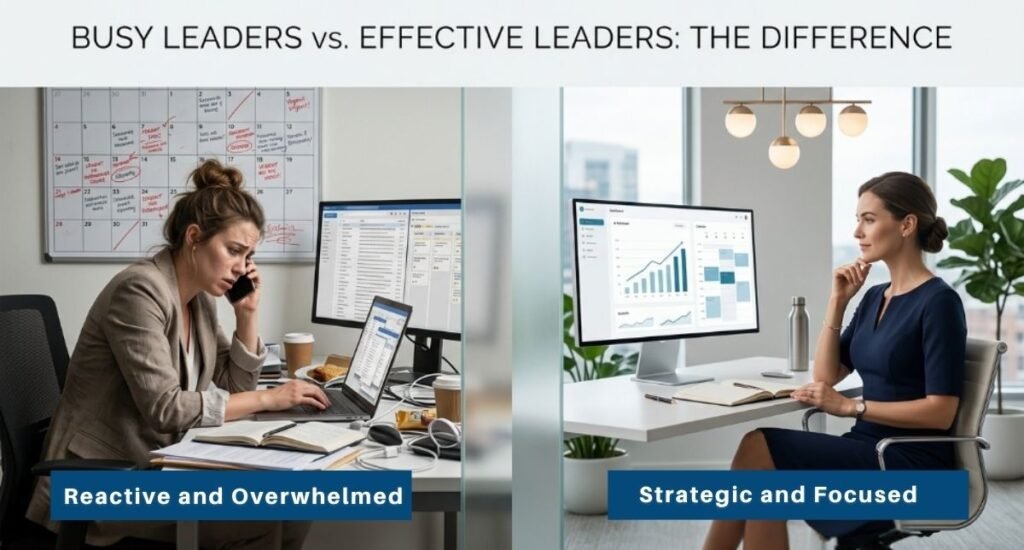
Wrote 72 hours last week, did nothing important, Answered 340 emails, Went to eleven meetings, Put out six fires, read 19 documents, Made dozens of quick decisions, with no strategic movement forward. Zero.
I am exhausted and falling behind on things that move the company forward. That is busy; that is not effective. When you are in them, they can feel the same.
Most founders wear their hours as a badge, “I pulled an all-nighter,” “I haven’t taken a weekend in months,” “I’m up at 5am every day,” etc. Congrats you’re exhausted. Doesn’t mean you’ve built anything.
Here is what busy looks like:
- Calendar booked solid end to end.
- Every hour filled with something. No breaks.
- Inbox always at 47 unread messages.
- Always catching up on something.
- In every meeting contributing nothing.
Making rapid-fire decisions (because you didn’t take the time to think), agreeing to everything (because saying no feels like you are missing out).
Looks productive. Looks impressive to people that look at how visible someone is.
Here is what effective looks like:
- Gaps in the calendar.
- Space to think.
- Time to breathe.
- Responds to around 10 emails that matter.
- Ignores/Delegates the rest.
- Attends 3-5 meetings: runs 2 of them and contributed to all of them.
- Decisions made are few but correct (because you took the time to think). Say no to almost everything. Only say yes to the things that compound.
Two founders run similar-sized companies.
Founder A:
- First one in, last one out. (Mentions it frequently so everyone knows.)
- Emailing at 11pm.
- Slack’s the team on Sunday.
- Taking calls during lunch.
- Involved in everything.
- Has an opinion on every decision.
- Checks every deliverable.
- Been working himself into the ground for 18 months and revenue has been flat for 18 months.
Founder B:
- Normal business hours.
- Leaves at 6PM usually.
- Only emails during work hours.
- Weekends are off.
- Involved in 3 things: strategy, important clients, and leadership hiring.
- Everything else is delegated to people he trusts.
- Looks like he is doing half the work.
- Revenue is up 40% over the same period.
The difference is not the amount of effort put forth. The difference is focus.
- Busy leaders are abundant. Effective leaders are selective.
- Busy leaders respond to everything. Effective leaders choose what needs a response.
- Busy leaders go to all the meetings. Effective leaders determine if the meeting should occur.
- Busy leaders fix every issue. Effective leaders want to know why the issues are recurring.
- Busy leaders perceive themselves as productive. Effective leaders see themselves as creating progress.
Busy is simply going through the motions of reacting/responding to everything that makes noise. Saying yes, being available, responding to whatever is loudest. Effective requires choosing what is truly important. This is uncomfortable because it requires accepting that most things aren’t.
Example from my last week:
Tuesday morning, I had 11 things on my to-do list, and I could’ve completed all of them, but still I would’ve felt accomplished.
Instead, I asked myself, “Are either of these items that will move us forward?” and then focused on two items, and I spent 3 hours on them, was able to complete deep work without interruption, and completely ignored the other 9 items. I felt unproductive for the entire day. I kept thinking about that incomplete list.
Results? By the end of the week? Those two items produced more value than the last month of completing a series of small tasks.
What effective leaders do differently:
- Protect their time like it is the most valuable resource they have. Because it is.
- Schedule thinking time on their calendars.
- Treat that time on their calendar like any other meeting that they cannot miss.
- Batch low-value work.
- Check email only twice a day.
- Do administrative work in blocks.
- Be extremely ruthless about meetings. “Can this be an email?” If yes, then it is an email.
- Delegate correctly, not just tasks but also ownership and decision-making.
- Say no constantly. To, opportunities, requests, quick chat. No is their default. Yes, it is rare.
None of this feels good, by the way.
Your inbox is still going to be full.
People are going to get upset that you’re not responding quickly.
Someone is going to tell you that you are “not engaged enough.”
But six months later? The busy founder is still in the same place. He is just more tired. The effective founder’s business has actually moved forward.
Simple Test:
Look at your calendar from last week.
Determine how many hours you spent on things only you can do:
- Strategy.
- Key decisions.
- Relationships that matter.
- Thinking time.
- Building what is next.
If it’s less than 50% of your total hours? You are not leading. You are just very expensive admin.
I am not saying don’t work hard. Work is important. But working on everything means you are working on nothing that compounds. Responding to every single email means you will never write the strategy document. Attending every single meeting means you will never have time to consider if you are building what is needed. Putting out fires every day means you will never figure out why the fires keep occurring.
The Shift:
Stop judging your day by how much you got done, and start judging your day based on if you moved anything that is truly important. It is possible that most days, that is one thing. Maybe two, and understand everything else is just noise masquerading as productivity.
Busy feels productive because you are moving. Effective is productive because you are moving towards something that is meaningful, but they are completely different.
One leaves you exhausted and stagnant. The other creates something that lasts. The choice is yours.