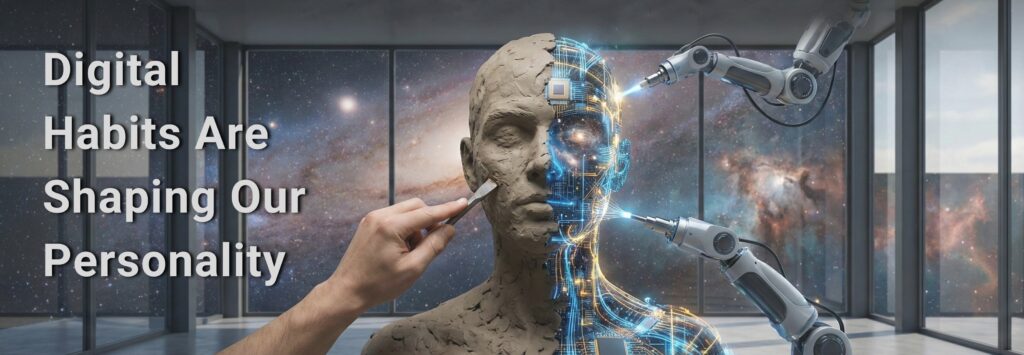
Your phone is aware of the time when you wake up. The apps are aware of your preferences. The digital routine is more familiar with you than you think. In 2025, a person’s character is no longer dependent only on family, society, or the environment but is also largely determined by our digital habits.
The way we scroll, communicate, search, consume content, and interact with technology has reached the point where it is starting to have an impact on our behaviour, thinking patterns, emotions, and even identity. This blog delves into how our daily digital habits silently change our identity.
1. The Rise of Micro-Attention: Our Patience Is Shrinking
One of the major changes in our lives brought about by the short videos, instant responses, and fast-loading feeds is that our brains have adjusted to the need for speed. We now do what could be called fragmentary information processing, getting a notification for a few seconds here, a swipe there, or a quick notification somewhere.
This micro-attention has altered our behaviour in such a way that we are hardly aware of it:
- We frequently change the task we are engaged in without completing the previous one.
- We become impatient quickly.
- We choose to consume shorter content rather than deep-diving into the long-form of a topic.
These things, over time, rewire our cognitive patterns, which, in turn, affect the way we talk, think, and make decisions.
2. Algorithms Are Shaping Our Interests

The content that is shown to us on the web is not random anymore; instead, it is personalised. Algorithms learn from our actions and then deliver to us such content as is most likely to keep us engaged. Therefore:
- Our interests change as a result of the recommendations made by the apps.
- Our beliefs are affected by the content that we see repeatedly.
- Our interests become dependent on the trends that appear in our feed.
This is the subtle loop that works for us: We are the ones who program the algorithms, and, in turn, algorithms influence us.
3. Digital Communication Is Redefining Confidence
In 2025, communication mostly takes place through screens i.e., messages, voice notes, video calls, and social media. As a result, it has changed the way we express ourselves.
- People are getting more and more confident with communication on the internet but at the same time, they become more shy and reserved when they are face to face with someone.
- Communicating via typing seems more secure than talking.
- Doing a post seems to be more doable than showing your feelings to someone face to face.
The transition of language to a different medium has an immediate effect on communicative skills which, in turn, affect the development of personality traits such as social confidence, assertiveness, and vulnerability.
4. The “Always-On” Lifestyle Is Affecting Emotional Health

Notifications, reminders, messages, and updates it seems as if our mind is always on the go and rarely gets a break. This lack of mental rest has led to various emotional issues, which, in turn, are the consequences of constant connection:
- When we are offline, we get stressed.
- We feel the need to respond immediately to the requests made to us.
- We find it challenging to mentally disconnect even when we are taking a rest.
Such habits impact our personality because they increase anxiety levels, decrease emotional resilience, and make us develop a reactive mindset instead of a calm one.
5. Curated Identities Are Influencing Self-Perception
Social networks not only allow but also encourage people to present the most attractive version of themselves. After some time, this has a very powerful impact on how we perceive our very own identity.
People today compare themselves not with real people but with the digital versions of these people that have been filtered, edited, and perfected.
This strongly affects:
- Self-esteem
- Body image
- Lifestyle expectations
- Personal goals
The virtual sphere is setting new standards that fundamentally alter the personality from the inside out.
6. Constant Information Access Is Changing How We Think

Previously, individuals used to memorize the information themselves. Nowadays, however, this task has been handed over to devices.
This, in turn, leads to changes in cognitive behaviour:
- We store less information but more sources.
- We prefer to do a quick search rather than getting a deep understanding.
- We acquire knowledge at a high speed; however, we forget at a high speed as well.
These habits give rise to a new kind of personality that is analytical yet easily distracted, informed yet dependent on technology.
7. Digital Routines Are Becoming Personality Anchors
Our everyday digital activities such as checking the weather, going through emails, browsing apps, listening to certain playlists, reading news not only nourish the mind but also serve as emotional anchors throughout the day.
These habits affect personality by changing:
- Mood
- Motivation
- Focus
- Productivity
Gradually, one’s personality becomes in tune with the digital workflow. For instance, a person who is in the habit of checking financial apps on a daily basis will have a different way of thinking from a person who is into checking gaming or shopping apps first. Our digital decisions affect our mindset.
Conclusion
Digital habits in 2025 are far beyond mere habits; they are “personality architects”. They determine the way we think, the way we feel, the way we behave, and the way we perceive ourselves in the world. Even though technology brings us great opportunities, it also gently persuades our personality in small, almost imperceptible, ways.
Understanding these effects gives us a chance to figure out the digital sphere that we want to be in instead of the digital sphere silently dictating to us.
In case you want your personality to be more robust, calmer, and more transparent, it is the first step to knowing which digital habits contribute to its development.